A Universal File Server
A Universal File Server
A. D. Birrell and R. M. Needham, in IEEE Transactions on Software Engineering, Vol SE-6, No. 5, September 1980, pp. 450-453.
One of the challenges in this next group of papers is picking which ones to discuss. The advent of networks saw the blossoming of the idea of centralizing storage and having different computer systems accessing it via those networks. By the time this paper is published quite a few network based file server solutions had been constructed and described within the literature - and we will get to them.
The authors here decided to try and extract generality from these works. So in this paper we step back and look for some generality.
This is a rather short paper - four pages.
The authors describe the division of responsibilities in a file server: the "high-level functions more properly associated with a filing system" and "functions belonging to a backing store server" [emphasis in the original]. When I read this I thought that this made sense: we have a functional layer that creates a name space, attributes, etc. and a storage layer that keeps track of storage blocks.
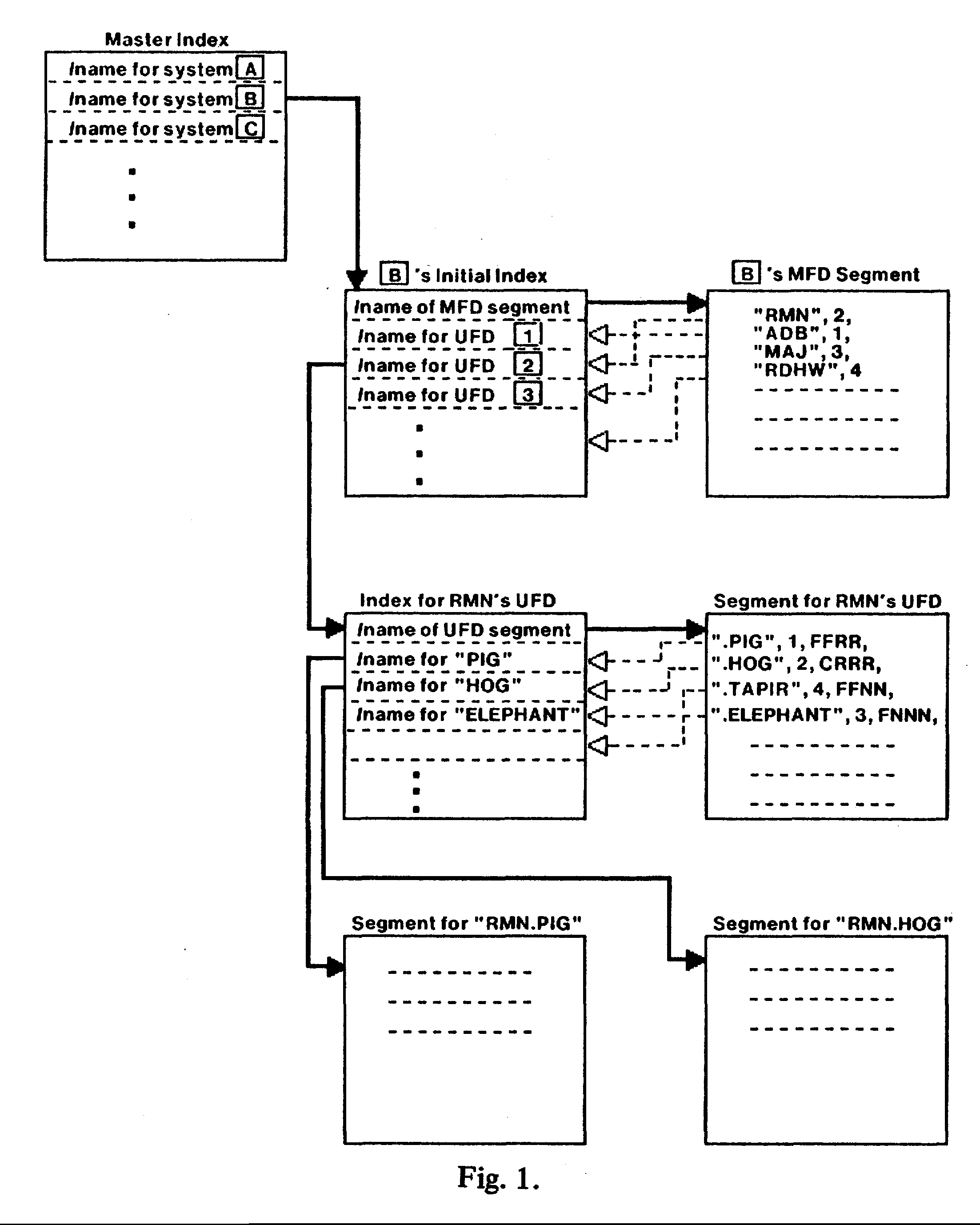
 By splitting out this functionality, the authors then suggest that the backing store server is a point of commonality that can be used to support a range of higher level services. Thus, "[t]he backing store server is the sole agency concerned with allocating and relinquishing space on the storage medium." To achieve this goal the authors propose a universal system of indexes as shown in Figure 1 (from the original paper).
The authors argue for a master table that presents the per-system name space. For each of these namespaces, there is a corresponding master file directory (MFD) and a collection of user file directories (UFDs) that are used to organize the user's information into a hierarchy.
We note that the files, UFDs and MFD are all stored in storage elements - segments - that are managed by the file server. Thus the file server is responsible for:
By splitting out this functionality, the authors then suggest that the backing store server is a point of commonality that can be used to support a range of higher level services. Thus, "[t]he backing store server is the sole agency concerned with allocating and relinquishing space on the storage medium." To achieve this goal the authors propose a universal system of indexes as shown in Figure 1 (from the original paper).
The authors argue for a master table that presents the per-system name space. For each of these namespaces, there is a corresponding master file directory (MFD) and a collection of user file directories (UFDs) that are used to organize the user's information into a hierarchy.
We note that the files, UFDs and MFD are all stored in storage elements - segments - that are managed by the file server. Thus the file server is responsible for:
 By splitting out this functionality, the authors then suggest that the backing store server is a point of commonality that can be used to support a range of higher level services. Thus, "[t]he backing store server is the sole agency concerned with allocating and relinquishing space on the storage medium." To achieve this goal the authors propose a universal system of indexes as shown in Figure 1 (from the original paper).
The authors argue for a master table that presents the per-system name space. For each of these namespaces, there is a corresponding master file directory (MFD) and a collection of user file directories (UFDs) that are used to organize the user's information into a hierarchy.
We note that the files, UFDs and MFD are all stored in storage elements - segments - that are managed by the file server. Thus the file server is responsible for:
By splitting out this functionality, the authors then suggest that the backing store server is a point of commonality that can be used to support a range of higher level services. Thus, "[t]he backing store server is the sole agency concerned with allocating and relinquishing space on the storage medium." To achieve this goal the authors propose a universal system of indexes as shown in Figure 1 (from the original paper).
The authors argue for a master table that presents the per-system name space. For each of these namespaces, there is a corresponding master file directory (MFD) and a collection of user file directories (UFDs) that are used to organize the user's information into a hierarchy.
We note that the files, UFDs and MFD are all stored in storage elements - segments - that are managed by the file server. Thus the file server is responsible for:
- Keeping track of its initial index
- Preserve the names stored in the MFD and UFDs
- Reclaim (delete) the entries in the MFD and UFDs when an entry is deleted
- Manage storage space